

A swallowed drop of air freshener oil isn’t a moment to guess your way through. Even a car air freshener for dog smell can need prompt, product-specific advice if someone swallows its oil. The amount alone can’t tell you what to do next.
It’s understandable to worry about making things worse, especially when you’re unsure what was swallowed. Start with the safest immediate steps: rinse the person’s mouth, don’t make them vomit, and keep the product packaging close. If they’re unconscious or having difficulty breathing, call 999 now. In England, Scotland and parts of Wales, call 111 for urgent medical advice when it’s not a life-threatening emergency.
This guide explains what to do straight away, which symptoms need urgent attention, and what product details to have ready when you seek help. It also covers first aid for skin or eye contact and practical ways to prevent another exposure. Act first, identify the product, and get medical advice rather than trying to judge the risk alone.
Key Takeaways
- Treat suspected air freshener oil ingestion as a medical-advice question, not a wait-and-see test. Call 999 for an emergency or seek urgent advice through 111 when there are no emergency symptoms.
- Don’t judge the risk by the amount or scent alone. Keep the container or label handy so you can identify the exact product.
- Know which symptoms need emergency help and which still call for prompt medical advice, even if they seem mild.
- Skin and eye contact need different first-aid steps from swallowing. Rinse the affected area and seek further help when needed.
- Whether you use a car air freshener for dog smell or another fragrance, store it securely and follow its label to help prevent another exposure.
Swallowed air freshener oil: what to do immediately
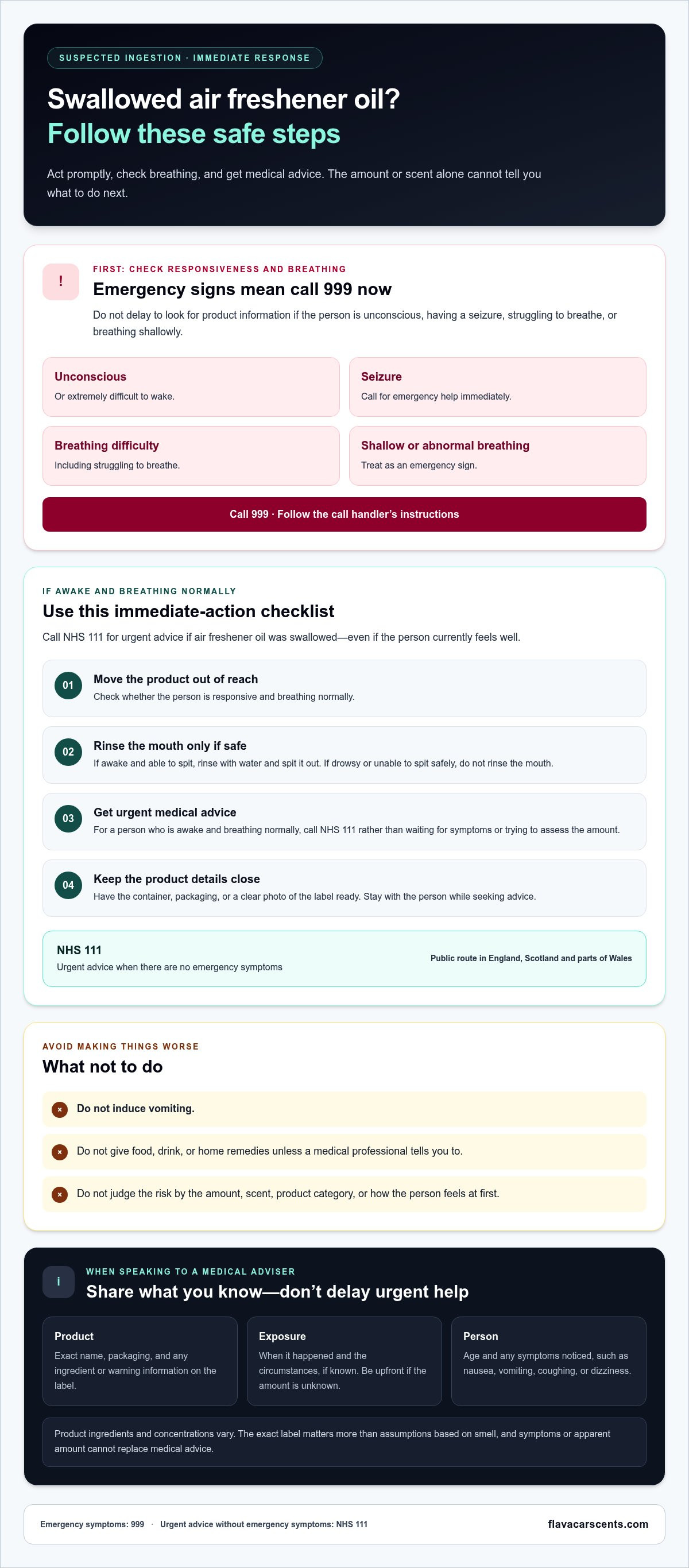
Treat suspected air freshener oil ingestion as a medical-advice question, not a wait-and-see test. Stay calm, act promptly, and don’t try to judge the risk from the amount or scent alone.
First, check responsiveness and breathing. Call 999 for an emergency, or contact NHS 111 for urgent advice if there are no emergency symptoms.
The first steps to take after someone swallows fragrance oil
- Move the product out of reach. Check whether the person is responsive and breathing normally. If they’re unconscious or having difficulty breathing, call 999 now.
- Rinse the mouth. If the person is awake and able to spit, have them rinse their mouth with water and spit it out.
- Get urgent medical advice. If there are no emergency symptoms, call NHS 111. In England, Scotland and parts of Wales, 111 is the public route for urgent advice about possible poisoning.
- Keep the product details close. Have the container, packaging or a clear photo of its label ready. Tell the adviser what was swallowed, when it happened, and any symptoms you’ve noticed.
Don’t induce vomiting. Don’t give food, drink or home remedies unless a medical professional tells you to. If the person is drowsy or unable to spit safely, don’t try to rinse their mouth. Seek urgent advice instead.
Fragrance products differ in their ingredients and concentrations, so the label matters more than assumptions based on smell. Some scent ingredients are Volatile Organic Compounds, but that term alone can’t identify the risks of a particular product or predict the effect of swallowing it.
When to call 999 or seek urgent help
Call 999 immediately if the person is unconscious, having a seizure, struggling to breathe or breathing shallowly. These signs need emergency attention. Follow the call handler’s instructions, and don’t delay to search for product information.
If the person is awake and breathing normally but has swallowed oil, call NHS 111 for urgent advice rather than waiting for symptoms or trying to assess the amount yourself. This applies whether the product was a car air freshener for dog smell or another fragrance. Stay with the person while you seek help, and share the product label details with the medical professional.
Why swallowed car air freshener oil needs product-specific advice
“Air freshener oil” isn’t one standard formula. Car fragrances come in different formats, and their ingredients and concentrations can vary. A wood diffuser and a vent clip, for example, aren’t interchangeable products. The scent or product category alone can’t tell a medical adviser what was swallowed or how to assess the exposure.
Product-specific assessment should guide the next steps, not a guess based on the fragrance, amount or symptoms. Don’t assume a small amount is harmless, and don’t wait for symptoms before seeking advice. The NHS explains what to do after a suspected poisoning in its UK guidance on what to do for poisoning.
What information to have ready when seeking advice
Gather what you can without delaying an urgent call. The product’s exact name and packaging can help identify the formulation. If the label lists ingredients or gives safety instructions, keep it nearby or take a clear photo.
- The product name and any ingredient or warning information on the label.
- When the exposure happened and, if known, the circumstances.
- The person’s age and any symptoms you’ve noticed.
Be upfront if you don’t know the amount. Don’t taste the product or handle a spill unnecessarily to find out more. If emergency signs are present, call 999 first. Collecting details can wait until help is on the way.
Why amount and symptoms don’t replace medical advice
It can be tempting to judge the risk by how much seems to be missing or by whether the person feels unwell. Neither gives a dependable answer on its own. The amount may be unclear, and different formulations mean the same apparent quantity doesn’t necessarily describe the same exposure.
Nausea, vomiting, coughing or dizziness are useful details to report, but they can’t identify the product or reliably show how serious an exposure is. Feeling fine immediately afterwards doesn’t prove that medical advice is unnecessary either. Tell the adviser what you know and follow their instructions rather than trying to monitor or manage the exposure alone.
If the product was a car air freshener for dog smell, share that context, but use the exact label or packaging to identify it. “Dog smell” describes why someone chose the fragrance, not what it contains. Once it’s safe to do so, secure the product away from children and animals.
Symptoms after swallowing air freshener oil: when to get help
Call 999 now if the person is unconscious, having a seizure or struggling to breathe. Don’t wait to see whether symptoms pass. If they’re awake and breathing normally but have swallowed air freshener oil, contact NHS 111 for urgent advice, even if they currently feel well. The NHS advice on poisoning explains when to use 999 and 111.
Signs that need emergency attention
Get emergency help for severe or rapidly worsening symptoms, especially:
- Loss of consciousness or extreme difficulty waking the person.
- A seizure.
- Shallow, difficult or abnormal breathing.
For any of these signs, call 999. Follow the call handler’s instructions. Don’t try to make the person vomit or give them food or drink while waiting for help.
Symptoms that still need prompt medical advice
Nausea, vomiting, coughing or dizziness after swallowing fragrance oil are reasons to seek prompt advice. If the person is conscious and breathing normally, call NHS 111. Tell the adviser what symptoms have appeared, when they began, and the exact product if you have its label or container. If their condition worsens or breathing becomes difficult, call 999.
Symptoms can appear soon after exposure or be delayed, so don’t use a symptom-free spell as proof that everything is fine. A checklist can’t tell you how hazardous a particular product is. Symptoms can’t reliably identify product toxicity; the product and exposure details need professional assessment.
Stay with the person while arranging advice, and keep the product details ready. Whether the fragrance was chosen as a car air freshener for dog smell or for another reason, its intended use and scent don’t indicate what swallowing it may do. Contact medical services promptly rather than waiting for a particular symptom to appear.
What to do if air freshener oil gets on skin or in eyes
Oil on skin or in an eye needs a different response from swallowing. Start rinsing straight away. Don’t use household cleaners, vinegar or other substances to try to neutralise the fragrance. Check the product label if it’s immediately available, but don’t delay rinsing to find it.
If fragrance oil touches skin
Rinse the affected skin under plenty of cool or lukewarm running water for 15 to 20 minutes. Remove contaminated clothing while rinsing if you can do so safely and without spreading the oil to other skin. Don’t scrub hard or apply creams or solvents unless a medical professional advises you to.
If irritation continues, the skin becomes painful or a large area is affected, seek prompt medical advice. Call NHS 111 in England, Scotland and parts of Wales if you’re concerned and it isn’t a life-threatening emergency. If the person becomes seriously unwell or has difficulty breathing, call 999.
If fragrance oil gets into the eyes
Act quickly. Hold the eyelids open and gently rinse the eye with clean, lukewarm running water for 15 to 20 minutes. Let the water flow across the eye rather than directly forcing it in. Remove contact lenses if they come out easily, but don’t delay rinsing to do this. Don’t rub the eye.
Get urgent medical advice if pain, redness, watering or blurred vision continues after rinsing, or if you’re unsure whether the eye has been fully flushed. Contact NHS 111 where available. Call 999 for a life-threatening emergency, such as severe breathing difficulty or collapse. Keep the product label nearby to help explain what caused the exposure.
These steps are for skin and eye contact, not swallowing. If oil has also been swallowed, follow the ingestion advice and contact a medical adviser. Whether the product was a car air freshener for dog smell or another fragrance, its intended use doesn’t determine the right first aid. Use the product label to identify it, and keep fragrance products secured away from children and animals.
Once the immediate safety steps are clear, you can explore car fragrance formats and keep the packaging information accessible for future reference.
Prevent another air freshener oil exposure and know what happens next
Once you’ve contacted a medical professional, follow their advice for that person and product. There isn’t one monitoring period or follow-up plan that suits every exposure. An adviser may give specific instructions about what to watch for or whether further assessment is needed. If symptoms appear, change or worsen, seek help again as directed. For an emergency, call 999.
Keep the container and packaging available in case a clinician or adviser needs to identify the contents. Follow their directions about observation, treatment or further assessment, even if the person seems well. Online comments and general product descriptions can’t replace advice based on the actual product and circumstances.
What information to keep after the first call
Keep the product name, label and packaging together and easy to find. If you speak with a different medical professional later, these details can help them understand which fragrance product was involved. Note any instructions you’re given and the symptoms or changes you’re asked to look out for. Don’t start a different treatment or change the advised plan based on a forum post or product review.
Simple ways to reduce accidental access
Prevention starts with where fragrance products are kept. Store them securely, in their original packaging where possible, and follow the product label and safety instructions. Don’t leave loose oils, open containers or fragrance products within reach of children or animals. Put a product away promptly after use rather than leaving it on a surface where a curious child or pet could access it.
- Choose a secure storage place that children and animals can’t reach.
- Keep the label and packaging with the product so its information remains available.
- Follow the product’s instructions for use, storage and disposal.
A car air freshener for dog smell is still a fragrance product, not a treatment for a pet or a medical problem. Don’t assume any fragrance product is suitable for children or animals. Keep it inaccessible and follow its specific safety instructions.
If exposure happens, seek medical advice first. Fragrance products are not medical treatments. Once the immediate safety questions are handled, use product information only for its intended purpose and keep the product stored securely between uses.
Stay calm, act quickly and keep safety first
If someone may have swallowed air freshener oil, don’t wait to see what happens. Call 999 for an emergency, such as difficulty breathing or loss of consciousness. If there are no emergency symptoms, contact NHS 111 for urgent advice. Don’t induce vomiting, and keep the product label or packaging ready so medical professionals can identify what was involved.
Fragrance formulas vary, and symptoms or the apparent amount swallowed can’t reliably tell you the level of risk. Follow medical advice for next steps, and store fragrance products securely away from children and animals. A car air freshener for dog smell is for scenting your vehicle, not treating a medical issue.
When the immediate safety questions are behind you, Flava Car Scents offers car fragrance formats including vent clips, sprays, tins and wood diffusers. Explore Flava Car Scents fragrances for your vehicle, and keep every product stored and used according to its label.
Frequently Asked Questions
What should I do immediately if I swallow air freshener oil?
Seek product-specific medical advice promptly. Call 999 if the person is unconscious, having a seizure, struggling to breathe or facing another life-threatening emergency. If there are no emergency symptoms, contact NHS 111 for urgent advice. Don’t induce vomiting or try a home remedy. Keep the product packaging nearby if it’s easy to reach, but don’t delay getting help to find it.
Should I make someone vomit after swallowing car air freshener oil?
No. Don’t try to make someone vomit unless a qualified medical professional specifically instructs you to. Vomiting can increase the risk of the substance entering the lungs. Contact NHS 111 for urgent advice if there’s no life-threatening emergency, or call 999 if the person is seriously unwell. Share the product label, approximate time of exposure and any symptoms with the medical adviser.
Should I call 999 or NHS 111 after swallowing fragrance oil?
Call 999 if the person is unconscious, having a seizure, struggling to breathe or experiencing another life-threatening emergency. If they’re awake and breathing normally, contact NHS 111 for urgent advice about the product and exposure. Don’t wait for symptoms to appear before seeking guidance. If their condition worsens while you’re getting advice, call 999. Keep the product packaging ready if it’s available.
What symptoms can happen after swallowing air freshener oil?
Possible symptoms include nausea, vomiting, coughing or dizziness, but symptoms vary with the product and exposure. Whether it was a car air freshener for dog smell or another fragrance, the scent won’t reveal the ingredients or the risk. Contact NHS 111 promptly and explain what happened. Call 999 for a life-threatening emergency, such as unconsciousness, a seizure or difficulty breathing. Don’t use an online symptom list to decide someone is safe.
What should I do if air freshener oil gets in my eye or on my skin?
Treat skin or eye contact as a different exposure from swallowing. Follow the product label’s first-aid instructions and contact NHS 111 for urgent advice if you’re unsure what to do or symptoms persist. Don’t use household cleaners or attempt to neutralise the product. Call 999 if the person is seriously unwell or has a life-threatening emergency. Keep the product packaging available to help identify it.
What information should I give NHS 111 after an air freshener oil exposure?
Tell the adviser the product name, any details on its label, when the exposure happened, the approximate circumstances, the person’s age and any symptoms. Keep the packaging nearby if it’s easy to access, but don’t delay calling to find it. If you don’t know the amount, say so rather than guessing. Follow the adviser’s instructions, and don’t judge the risk by fragrance strength or smell alone.


Leave a comment
This site is protected by hCaptcha and the hCaptcha Privacy Policy and Terms of Service apply.