
Table of Contents
- Why Subtle Car Fragrances Beat Strong Ones
- Types of Car Air Fresheners Compared
- How to Remove Bad Odours from Car Interiors First
- Matching Scent Intensity to Cabin Size and Sensitivity
- Car Air Freshener Safety Standards and Air Quality
- Best Floral Car Scents for Spring and Beyond
- Conclusion: Building a Subtle Scent Routine
- Frequently Asked Questions
Last Updated: October 4, 2026
Why Subtle Car Fragrances Beat Strong Ones
Subtle car fragrances sit quietly in the background of your cabin, freshening the air without dominating it.
Strong scents cause problems fast: headaches, nothing masked, and a nose that wears out within minutes.
Subtle scents do the opposite. They work with air circulation instead of fighting it.
Below, we explain how to pick a lighter scent, where to place it, and which fragrances suit spring and beyond.
Types of Car Air Fresheners Compared
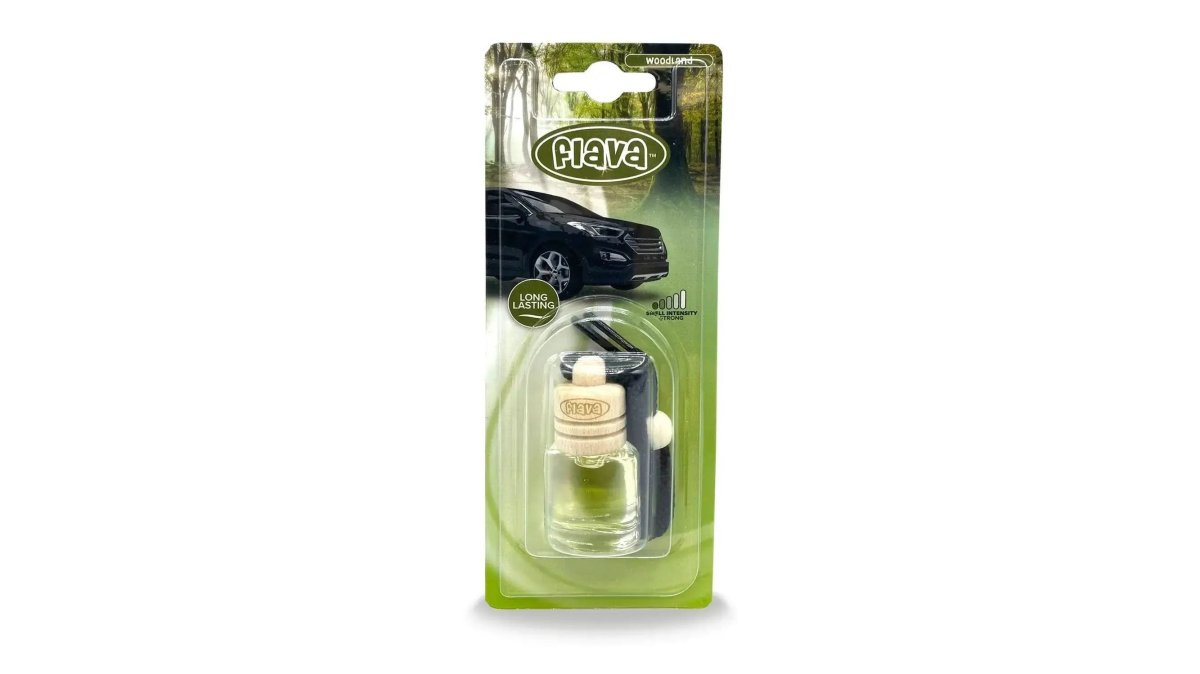
Car air fresheners fall into four groups: wood diffusers, scent tins, vent clips, and sprays. Each controls intensity differently, and that control matters more than the fragrance itself.

Here is how they compare:
| Type | Intensity Control | Typical Duration | Best For |
|---|---|---|---|
| Wood diffuser | Re-soak as needed | Weeks per bottle | Sensitive noses, small cabins |
| Scent tin | Fixed, steady release | Up to 60 days | Cup holders, under seats |
| Vent clip | Airflow-dependent | Varies | Quick top-ups |
| Spray | Instant, short-lived | Minutes | Odour emergencies |
Wood Diffusers, Scent Tins and Vent Clips
Wood diffusers release fragrance through evaporation: soak a natural wood cap in scented oil, then hang the bottle from your mirror. The scent builds slowly and stays gentle.
Our Flava Wood Scent Car Air Freshener in Woodland works exactly this way. The Ocean Mist version suits drivers who prefer a fresh, perfume-inspired profile.

Scent tins use scent bomb pads, sit in a cup holder and release steadily for up to 60 days. Our Couture Scent Tin in Oud Wood blends spicy, wood and vanilla notes; the Porfino tin leans citrus, floral and amber.

Vent clips depend on your ventilation system, so intensity swings with fan speed.
How to Remove Bad Odours from Car Interiors First
No fragrance fixes a dirty cabin. If you add scent on top of old smells, you get two smells fighting. Here is the order that works:
- Remove all rubbish, mats and loose items
- Vacuum seats, carpets and boot lining
- Wipe hard surfaces with a damp microfibre cloth
- Clean the ventilation system by running the fan with fresh air
- Leave windows open for an hour to air the cabin out
- Only then add your freshener
Most people skip step four. Dust and debris sit in the vents and blow back into the cabin every time you drive. A quick blast of fresh air costs nothing and removes a common odour source.
Check under seats too. Spilled drinks and food collect there and gassing off continues for weeks.
Matching Scent Intensity to Cabin Size and Sensitivity
A scent that feels perfect in a large SUV can overwhelm a small hatchback. Cabin volume, air circulation, your own sensitivity and the surface the fragrance sits next to all change the result.
Small cabins need less. A three-door hatch has roughly half the air volume of a large estate, so the same wood diffuser reads about twice as strong.
Why Some People React and Others Don't
Chemical sensitivity is real and common. People with asthma, allergies or migraine triggers often react to volatile organic compounds (VOCs), carbon-based chemicals that evaporate from scented products at room temperature. Fragranced products can also contain phthalates, used to make scent linger.
A common pattern is a scent feeling fine for ten minutes, then producing a dull headache, a tickle at the back of the throat or a blocked nose.
Interior Material Compatibility
Fragrance oils and sprays do not treat every cabin surface the same way. Before you hang, clip or spray anything, check where it will sit:
- Dashboard plastics and trim, many are finished with a soft-touch coating that some solvent-based sprays will dull, cloud or leave tacky. Keep sprays off the dash entirely; spray onto a cloth or into the footwell airflow instead.
- Leather upholstery, leather is finished, but repeated contact with concentrated oil can darken the surface or leave a greasy patch. Never rest an open oil bottle directly on a seat.
- Fabric and Alcantara-style trim, porous, so oil soaks in and holds the scent far longer than you intended. A single spill can outlast the product itself.
The rule is simple: keep the fragrance in the air, not on the surface. Wood diffusers and scent tins that release by evaporation are lower-risk than sprays and oils that pool or drip.
Adjustable Intensity and Olfactory Fatigue
Adjustable intensity is the most useful feature in any car freshener, letting you dial the scent up or down instead of accepting whatever the product decides.
Flava Wood Scent Car Air Freshener - Woodland →
Olfactory fatigue works against you here. Your nose adapts to a constant smell within about twenty minutes. That is why drivers crank up the intensity, then wonder why the scent "stopped working."
The fix is simple. Use less, and refresh in bursts.
- Re-soak a wood cap only when you want a boost
- Move a scent tin further from your seat
- Take the freshener out for a day, then put it back
Climate Changes the Maths
Heat and humidity change how fast a fragrance evaporates, more than most drivers expect.
- Summer heat, a cabin parked in direct sun can reach well above 40°C. Oil evaporates faster through a wood cap, so the same diffuser may feel twice as strong as it did in spring. Re-soak less often, or move the diffuser out of the sun.
- Winter cold, evaporation slows sharply. A product that felt right in July can feel almost absent in January. This is normal, not a fault.
- Humidity, damp air carries scent molecules differently from dry air, and a humid cabin can make a light floral read sweeter and heavier than expected.
Intensity is not a fixed property of the product, it is a product of the product, the cabin and the weather. Adjust accordingly rather than replacing the freshener.
Car Air Freshener Safety Standards and Air Quality
Car air fresheners sold in the UK sit at the intersection of two regulatory regimes, and knowing which applies tells you a lot about how a product was made.
Which Rules Apply
- General product safety, all consumer products placed on the market must be safe in normal use. This is a baseline obligation on the seller, not a badge on the packaging.
- Cosmetic products, a product applied to the body (including some sprays and oils that contact skin) falls under UK cosmetics law, which requires a safety assessment, a responsible person established in the UK, and compliance with restrictions on certain substances.
- Chemical classification and labelling, fragrance ingredients themselves are regulated as chemicals. Some substances are restricted or banned in consumer products, and mixtures above certain thresholds must carry hazard labelling.
If you want to check current rules on scented consumer products, the UK government guidance on cosmetic and chemical product safety is the place to start. For air quality in enclosed spaces, see official guidance on indoor air quality.
What Is Actually in the Air
Air quality inside a car matters because cabins are small, sealed spaces and scented products add to whatever is already in the air. Two groups of chemicals are worth knowing by name:
- VOCs (volatile organic compounds), carbon-based chemicals that evaporate at room temperature. They come from fragrances, but also from plastics, adhesives, upholstery and cleaning products. In a hot parked car, VOC concentrations rise because heat drives evaporation.
- Phthalates, a family of chemicals often used as fixatives in fragrance, helping a scent linger. Some phthalates are restricted in cosmetics and in certain consumer products; others are not. "Phthalate-free" on a label is a meaningful claim, not marketing noise.
No car freshener improves air quality, it adds scent, it does not clean air. For genuinely fresher air, ventilation and source removal do the work; fragrance is the finishing touch.
Practical Habits That Reduce Risk
- Never place a freshener where it blocks your view of the road
- Keep liquids away from direct sunlight and heat, a bottle left on a sunny dash can pressurise and leak
- Follow the maker's instructions for activation and re-soaking; over-soaking a wood cap is the most common cause of an overpowering cabin
- Ventilate before you scent: run the fan on fresh air for a minute before adding fragrance, not after
A Note on "Natural" vs. "Synthetic"
"Natural" does not automatically mean safer, and "synthetic" does not automatically mean harsher. Some natural essential oils, citrus in particular, are common skin and airway irritants, and some are phototoxic. Well-made synthetic molecules can be purer and more predictable than a botanical oil of variable composition. The useful question is not natural versus synthetic, but: how many ingredients, how strong, and how well can you control the dose?
Best Floral Car Scents for Spring and Beyond
Floral scents suit spring because they feel light and clean after months of heavy winter air.
Look for these scent profiles:
- Citrus and floral blends, which feel bright without being sweet
- Soft amber bases, which add warmth without weight
- Green or watery notes, which read as clean rather than perfumed
Our Porfino tin fits this brief well. It pairs citrus and floral top notes with an amber base, so it opens fresh and settles gently.
Florals also layer well. A light floral in the cabin plus a neutral odour eliminator under the seat keeps things balanced.
Conclusion: Building a Subtle Scent Routine
The challenge with car fragrance is restraint. Most drivers over-scent, then blame the product when their nose switches off.
That is exactly how we build our range at Flava Car Scents. Every scent is inspired by world-renowned designer aftershaves and perfumes, tested for performance, and made to last without shouting.
Get started with Flava Car Scents and turn every drive into something quietly refined.
Frequently Asked Questions
What is a good subtle car air freshener?
A good subtle car air freshener releases fragrance gradually rather than all at once. Wood diffusers and scent tins work well because they rely on evaporation or scent bomb pads for slow, even release. Look for adjustable intensity so you can control how much scent fills the cabin. Flava's Wood Scent diffusers in Woodland or Ocean Mist, at £4.99, soak a natural wood cap that releases fragrance gently, and the 6ml bottle can be re-soaked only when you want a boost.
How long do luxury car scents typically last?
Longevity depends on the format and how often you reactivate it. Scent tins using scent bomb pads can keep a car fresh for up to 60 days, as with Flava Couture Scent Tins. Wood diffusers last until the oil is used up, and re-soaking the cap gives an instant burst without replacing the whole unit. Heat, direct sunlight and frequent re-soaking all shorten the lifespan, so park in shade and check the cap every couple of days.
Are there health considerations for car air fresheners?
Some air fresheners release volatile organic compounds (VOCs) and synthetic fragrance ingredients that can irritate people with chemical sensitivity or allergies. Choosing products with lower scent intensity, good air circulation and non-toxic formulations reduces exposure. If you are sensitive to strong smells, start with a subtle option and ventilate the cabin regularly. Anyone with a diagnosed respiratory condition should check ingredients and speak to a healthcare professional before using any fragrance product daily.
How do I stop a car fragrance from becoming overpowering?
Start with a low-intensity product and adjust from there. Place the freshener away from direct airflow from the vents, and only re-soak or reactivate it when the scent fades rather than on a fixed schedule. Olfactory fatigue means you stop noticing a scent after a while, so resist the urge to add more. If a scent still feels strong, remove it for a day and let the cabin air out before trying a lighter profile.


Leave a comment
This site is protected by hCaptcha and the hCaptcha Privacy Policy and Terms of Service apply.