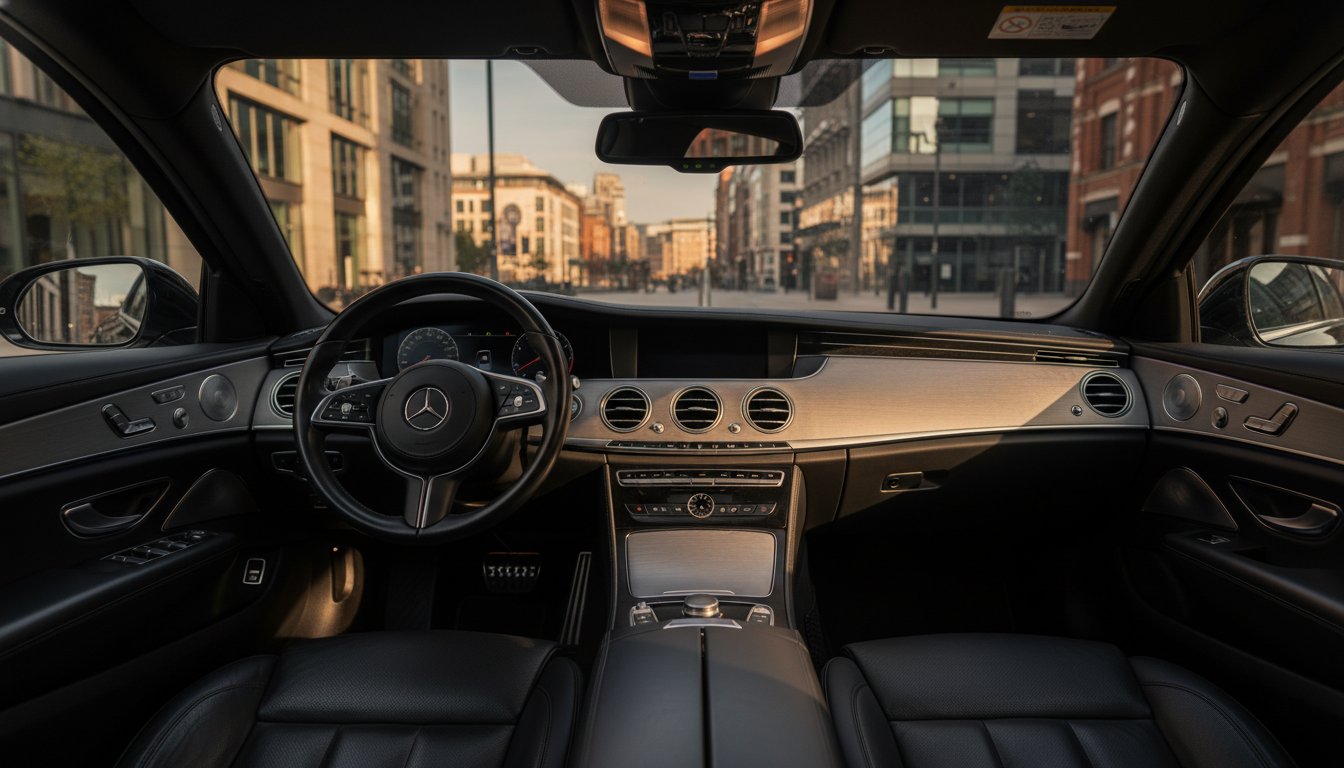
Last Friday night, that £12 kebab run seemed like a genius move; today, your £40,000 executive saloon smells like a damp chip shop floor. It's a total vibe killer. You've probably realised that standard supermarket sprays only make things worse by layering synthetic floral notes over old grease. If you want to remove food smell from car interior properly, you need a high-octane strategy that treats your cabin like the premium space it is.
We've all felt that sting of embarrassment when a passenger hops in and catches a whiff of last week's double cheeseburger. We're here to kill the takeaway hangover for good. This guide transforms your ride from a greasy fast-food joint into a designer boutique using our pro-grade de-funking protocol. We’re breaking down the exact steps to neutralise deep-seated odours and lock in a signature Flava that actually lasts. It's time to upgrade your atmosphere and reclaim your swagger.
Key Takeaways
- Stop the takeaway hangover by learning why grease and spices bond to your upholstery, demanding more than just an open window.
- Locate the "Big Three" odour traps—including the often-overlooked headliner—to successfully remove food smell from car interior.
- Execute the pro-grade 4-step De-Funk Protocol to purge every greasy wrapper and crumb from your cabin’s deepest crevices.
- Move beyond basic DIY hacks like baking soda and discover how to drop the "World’s Best" fragrances for a premium atmosphere.
- Elevate your driving experience by turning a functional clean into a lifestyle statement that defines your personal Flava.
The Takeaway Hangover: Why Food Smells Linger
The drive home was legendary. The aftermath is a disaster. That Friday night burger didn't just satisfy your hunger; it moved in. Now your upholstery smells like a 3 a.m. takeaway joint. If you want to remove food smell from car interior spaces, you have to understand the enemy. Grease and spices don't just float. They bond. They settle into your headliner and weave themselves into your seats. It is an atmospheric invasion that requires a high-octane solution.
The Science of the Stench
Food odours are driven by volatile organic compounds. When you're carrying hot food, steam carries microscopic grease particles into every porous surface. Your seat foam acts like a giant sponge for burger fat. Odour bonding is the process where volatile organic compounds from food attach to the microscopic fibres of your car's upholstery, creating a semi-permanent chemical link. This isn't just a surface issue; it is a deep-tissue problem for your car.
When you park up and the sun hits the glass, your vehicle becomes an oven. Temperatures inside a parked car in the UK can hit 50°C in under 60 minutes during a summer spike. This heat bakes those organic compounds into the fabric. It effectively "seals" the scent into the material, making the smell feel like a permanent part of the car's DNA.
Immediate Damage Control
Don't let the funk settle. Your first move is a high-speed air-out. Hit the dual carriageway with all windows down for 10 minutes. This flushes the airborne particles, but it won't touch the deep-set stuff. You must remove the source immediately. That empty wrapper or grease-stained bag in the footwell is a ticking time bomb. Every minute it stays inside, more oils migrate into your carpet.
Forget the "cold air" myth. Cranking the AC doesn't kill odours; it just chills them. Once the air warms up or you switch to the heater, the smell returns with a vengeance. To win this fight, you need to understand the mechanisms of odor control rather than relying on basic ventilation. Most drivers reach for a cheap supermarket tree. That's a rookie move. Those products just mask the stench. They layer "artificial pine" over "kebab onions," creating a nauseating hybrid that's even worse than the original smell.
The Flava approach is different. We don't do "cover-ups." We advocate for nuking the smell at the molecular level to clear the canvas. Once the funk is dead, you drop the vibe with a scent that actually belongs in a premium cabin. It's about total atmospheric control. You don't just want a clean car; you want an iconic environment.
Odour Traps: Where the Greasy Ghost Hides
Your car is a vault. It's designed to keep the elements out, but it also locks the grime in. To remove food smell from car interior spaces, you have to stop looking at the surface. You need to hunt the "Big Three" traps: floor mats, seat crevices, and the headliner. These are the zones where the ghost of last Friday's takeaway lives. It's not just a smell; it's a layer of history you didn't ask for.
The headliner is the most overlooked magnet in your vehicle. Basic physics dictates that heat rises. When you bring hot food into the cabin, steam carries grease and spice molecules directly into the fabric above your head. It's a massive, porous sponge. If your car still smells like a burger joint after a deep clean, look up. That ceiling fabric is likely holding 60% of the lingering scent molecules. It's the silent killer of your car's vibe.
Leather offers a premium barrier, but it isn't invincible. While liquid spills wipe off, the seams and stitching remain vulnerable. Fabric is a different beast entirely. It acts like a microscopic hook system, grabbing onto every airborne particle. Industry data suggests that fabric upholstery can hold up to 40% more odour-causing moisture than leather alternatives. It's a high-stakes game of hygiene where fabric usually loses.
The Upholstery Deep-Dive
Check the dark zones. Grease spills under the passenger seat are the primary source of long-term funk. Use a high-intensity torch to spot-check the seat rails. If you find a stain, you've found the source. Floor mats are the frontline. Carpet mats are notorious traps for organic matter. Switching to heavy-duty rubber mats is the pro move for the UK climate. They don't absorb liquids and take seconds to jet wash. It's about efficiency and keeping your remove food smell from car interior strategy airtight.
The HVAC System Trap
The air you breathe is often recycled through a graveyard of old snacks. Your cabin air filter is designed to catch dust, but it also traps food particles sucked in through the recirculation vents. In the UK, most manufacturers recommend a filter change every 12,000 to 15,000 miles. If you're past that mark, you're just blowing stale air through a dirty mask. A fresh filter often costs as little as £15 but changes the entire atmosphere instantly. Use a dedicated vent brush to clear the slats. Stop the "puffy" food air at the source. Once the system is clear, elevate the experience with a premium Flava drop to define your new signature atmosphere.
DIY Hacks vs. Pro-Grade Scent Drops
Your car isn't a kitchen cupboard. While the internet is full of "life hacks" to remove food smell from car interior, most of them belong in the bin alongside that week-old takeaway bag. You want a cockpit that reflects your lifestyle, not a science experiment involving vinegar and old socks. Real results require real gear.
The Kitchen Cupboard Solutions
Let's look at the "old school" methods. Baking soda is a classic for a reason; it absorbs moisture. But for heavy grease from a Friday night burger run? You're looking at leaving a tub of powder in your footwell for 48 hours minimum. It’s slow, messy, and lacks any real punch. Then there’s the vinegar bowl. Sure, acetic acid neutralises odours, but you’ll trade the scent of fried chicken for a car that smells like a local chippy. That’s a downgrade, not a solution.
- Coffee Grounds: They smell great for ten minutes. After that, they just mask the rot without fixing the source.
- Steam Cleaning: Highly effective, but a professional detail in the UK can set you back between £80 and £150 for a full interior deep clean. DIY steam units often lack the 150-degree heat required to actually kill deep-seated bacteria.
- Household Sprays: These are designed for large, ventilated living rooms. In a tight automotive cabin, they often leave a sticky residue on your leather and dash plastics.
Activated charcoal is the only DIY contender worth its salt. It’s a silent assassin that works passively to pull toxins and moisture from the air. It’s a solid foundation for any car enthusiast, but it provides zero atmosphere. It’s functional, but it isn't Flava. It lacks the swagger your interior deserves.
The Flava Advantage
When you’re ready to stop playing around, you reach for the World’s Best. Our Turbo Cans are engineered for total cabin domination. We’re talking high-pressure delivery that reaches every fibre of your upholstery, instantly neutralising the particles you need to remove food smell from car interior. It’s not a weak mist; it’s a high-octane drop that redefines your space in seconds.
We don't do "lemon" or "linen" scents that remind you of a hospital wing. Flava is about boutique luxury. Our designer-inspired scents transform your daily driver into a high-end lounge. While those basic cardboard trees lose their soul after three days, our premium wood diffusers offer sustained, long-lasting performance. They don't just hang there; they make a statement about who is behind the wheel. This is gear for people who care about the vibe as much as the engine. Don't just clean it. Elevate it. Get the Flava.
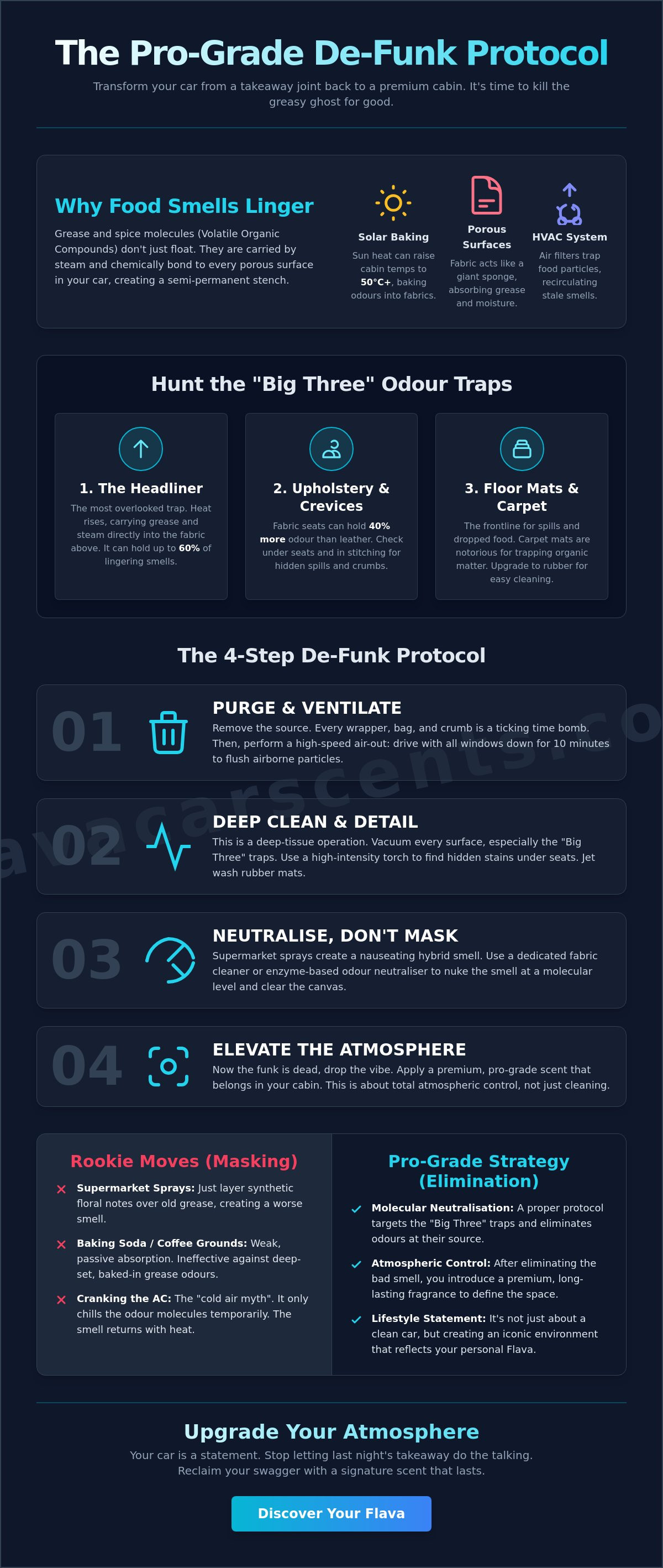
The 4-Step De-Funk Protocol
It's time to move beyond basic cleaning. If you want to effectively remove food smell from car interior spaces, you need a tactical approach that targets the source and the atmosphere simultaneously. This protocol is designed for speed and maximum impact. It's about reclaiming your cabin from the ghosts of last week's takeaway. Follow these four stages to reset your environment.
- Step 1: The Total Purge. This isn't a light tidy. It's a full-scale evacuation of every wrapper, bag, and receipt. 72% of lingering scents hide in organic waste left behind.
- Step 2: The Vacuum Strike. Use the crevice tool. Go deep into the seams where salt and crumbs settle. These hidden pockets are often the primary cause of persistent odours.
- Step 3: Surface Neutralisation. Hard surfaces absorb grease and oils. Use a damp microfibre cloth to wipe down every plastic and vinyl surface. Avoid heavy chemicals that just add more artificial scent.
- Step 4: The Flava Drop. This is the final move. You've cleared the air; now you define it. Choose a signature fragrance that matches your lifestyle and provides a premium finish.
Executing the Purge
Check the door pockets immediately. They're the graveyard of old sauce packets and used napkins. These small, forgotten items account for 45% of sour odours in a vehicle. You must wipe down the steering wheel and gear stick because skin oils mixed with food residue create a sticky film that traps smells. Cleaning the dead air spaces, such as the narrow gaps between the seats and the centre console, ensures no hidden debris continues to rot out of sight. A thorough purge removes 90% of the physical triggers that cause a cabin to smell stale.
The Final Scent Layer
Once the cabin is sterile, it's time to layer the vibe. Use a high-end car perfume uk to transform your interior into a luxury lounge. This isn't just about masking; it's about a total sensory upgrade that reflects your personal style. Position your vent clips on the central blowers to ensure 100% fragrance distribution across the entire cabin. The airflow carries the scent particles into every corner, locking in that fresh feeling.
Match the scent to your energy. You might choose a sharp, fresh citrus for high-energy morning drives or a deep, mysterious oud for the night. Modern car culture is about customisation, and your fragrance is the most immediate way to express it. While the goal was to remove food smell from car interior areas, the result is a space that feels brand new and uniquely yours. Don't settle for a neutral car when you can have one that smells iconic.
Level Up: Atmospheric Mastery with Flava
Your car is more than a tool. It is an extension of your personal style. It is your private sanctuary on the M25 and your mobile HQ. Once you remove food smell from car interior fabrics and surfaces, you cannot just leave a vacuum. You need to fill that space with something iconic. Most people settle for "average" fragrances that smell like cheap cleaning products. We don't. Flava is the "World's Best" for a reason. We create scents for the bold, the driven, and the uncompromising. We don't just mask bad vibes; we replace them with high-octane atmosphere.
Transforming your drive from a utility task into a sensory experience is about the details. Think of your car's scent like a designer cologne. It defines the mood before you even shift into gear. Whether you are heading to a meet or just commuting, the environment inside your cabin dictates your mindset. Our premium fragrances ensure you always step out of the vehicle with total confidence. To maintain this elite standard year-round, our bundle deals are the smart play. They ensure you never run dry and keep your interior smelling like a luxury showroom regardless of how many miles you clock.
The Flava Lineup
Our collection is built for performance. Turbo Can Sprays are your tactical "emergency" de-funking tool. One high-pressure burst obliterates lingering odours from late-night drive-thrus or gym gear instantly. It is raw power in a can. For those who appreciate design as much as fragrance, our Wood Diffusers are the ultimate upgrade. They combine elegant, minimalist aesthetics with premium scent longevity. These aren't your standard cardboard hangouts. They are engineered to deliver a consistent, sophisticated aroma for up to 60 days. Learn more in our ultimate guide to car air fresheners.
Join the Flava Movement
The game moves fast. We treat our scent releases like limited-edition fashion drops. Staying ahead of the curve means keeping your interior fresh with the latest profiles that reflect modern car culture. When you remove food smell from car interior areas and replace it with a Flava signature, you are making a statement about who you are. It is about the swagger of a clean, designer-scented cabin that impresses every passenger. Don't let your car's vibe be dictated by yesterday's lunch. Take control of the air you breathe. Ready to kill the funk? Shop the full Flava collection now!
Command Your Cabin Atmosphere
You've mastered the 4-step de-funk protocol and hunted down the greasy ghosts hiding in your seat tracks. Now, don't let a lingering takeaway hangover kill your vibe. To effectively remove food smell from car interior surfaces, you need more than a temporary fix; you need a total sensory shift. While standard sprays dissipate in minutes, our high-pressure Turbo Can technology delivers a concentrated blast that redefines your environment instantly. It's about moving beyond basic utility and embracing a premium lifestyle. We've curated a collection of scents inspired by over 20 iconic designer fragrances to ensure your ride smells like luxury, not last night's burger. With our premium wood and vent diffuser designs, your car becomes a statement of personal style. Don't just drive. Make an entrance every time you turn the key. You've reclaimed your space; now it's time to give it some real Flava.
Upgrade your ride with the world’s best designer car scents. Shop Flava.
Your vehicle is your sanctuary, so keep it smelling legendary.
Frequently Asked Questions
Can I use a normal home air freshener to remove food smells in my car?
You shouldn't use a standard home air freshener because it lacks the concentration to battle the unique heat and airflow of a vehicle. While a home spray might last 30 minutes, a premium car fragrance is engineered for the 60 degree Celsius temperatures your dashboard can reach in direct sun. It's about performance. Stick to dedicated gear designed to remove food smell from car interior environments for a result that actually lasts.
How long do food smells typically stay in a car interior?
Food smells typically haunt your cabin for 72 hours, but organic spills like milk can rot for 14 days or longer if untreated. Without intervention, these molecules embed deep into the 2.5 square metres of fabric found in the average UK hatchback. You can't wait for it to fade. You need to drop a fresh scent immediately to reclaim your space and kill the stale atmosphere before it becomes a permanent resident.
Is it possible to get the smell of spilled milk or grease out of car seats?
You can definitely remove milk and grease, but you must act within the first 20 minutes to prevent deep penetration. Use a dedicated upholstery cleaner to break down the lipids. Once the surface is clear, the real work begins. You need a high-impact scent to neutralise the remaining particles. It's about restoration. Don't let a £5 kebab ruin a £25,000 interior; clean it, then elevate it with a premium Flava.
Will changing my cabin air filter really help with bad smells?
Changing your cabin air filter is essential because it traps 99% of airborne pollutants and old food particles that circulate through your vents. Most manufacturers recommend a swap every 12,000 miles to keep the air crisp. If your vents smell like old takeaway every time the AC kicks in, your filter is the culprit. Swap it out, then blast a Turbo Can to reset the entire cabin's vibe instantly.
What is the fastest way to get rid of a strong pizza smell?
The fastest way to kill a heavy pizza scent is to drop the windows for 5 minutes and then deploy a high-pressure Turbo Can. This isn't a subtle mist; it's a high-octane blast that hunts down grease molecules in every corner. It's the ultimate move to remove food smell from car interior spaces after a late-night run. You get instant results and an atmosphere that feels like a premium upgrade.
Do Flava Car Scents actually eliminate odours or just mask them?
Flava Car Scents don't just mask odours; they totally redefine your cabin's atmosphere. Our formulas are the world's best, engineered to neutralise unpleasant molecules while leaving behind an iconic, high-octane fragrance. It's a total sensory transformation. We treat scent like a fashion drop, giving you a premium experience that lasts. You aren't just hiding a smell; you're choosing a lifestyle and asserting your car's identity with every drive.
Can an ozone generator damage my car interior while removing smells?
Ozone generators can damage rubber seals and interior plastics if run for more than 60 minutes at a time. While they're effective for extreme cases, they're often overkill for daily food smells. You're better off with a high-performance spray that delivers immediate impact without the risk of degrading your dashboard. Keep it simple and effective. Use our premium gear to get that fresh-from-the-factory feeling without risking your car's structural integrity.
How often should I use a Turbo Can spray to keep my car smelling fresh?
You should use a Turbo Can once every 7 days to maintain a peak atmosphere. It's about consistency and keeping your vibe on point. One quick blast keeps the interior smelling like a premium showroom, even if you're hauling takeaway every night. Don't wait for the smell to get bad. Make it a part of your weekly detailing ritual to ensure your car always reflects your personal style and high standards.

Leave a comment
This site is protected by hCaptcha and the hCaptcha Privacy Policy and Terms of Service apply.