
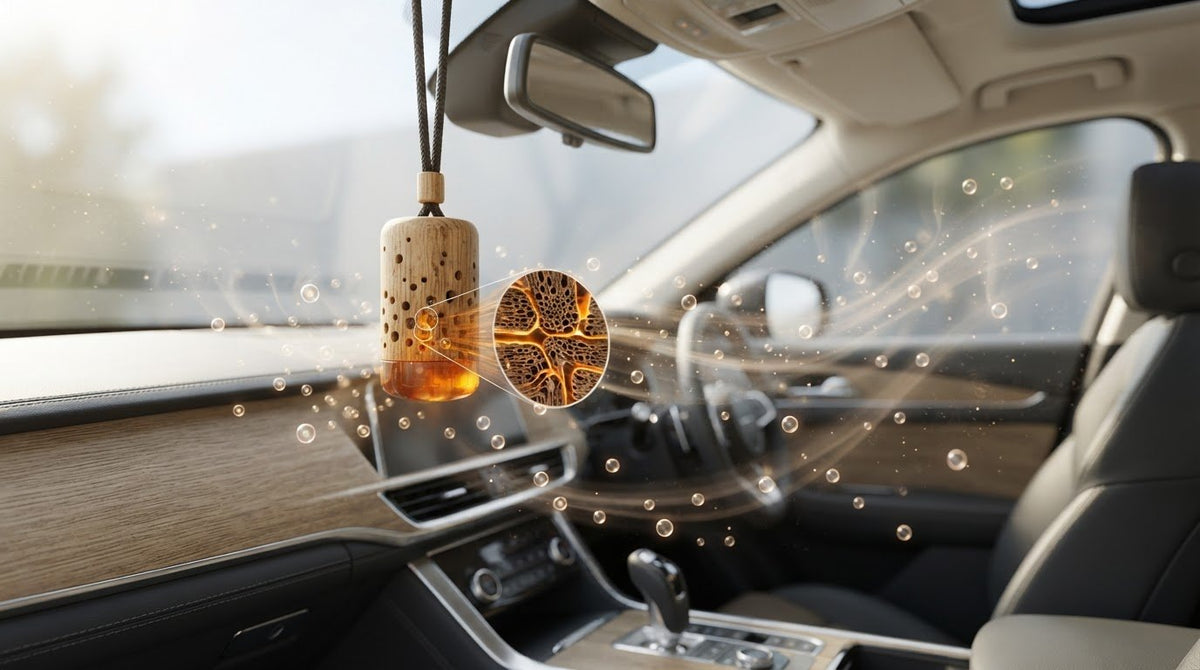
Wood can absorb scented oil into its tiny pores and surface spaces, then release fragrance as molecules evaporate into the air. So, how do wood diffusers release scent? In short, the wood holds the fragrance, evaporation carries it into the air, and airflow helps move it around.
If the scent seems stronger one day and softer the next, several things could be changing: temperature, airflow, humidity, the wood’s structure and surface area, or the fragrance itself. Your nose can also become accustomed to a familiar scent, making it seem fainter even while it is still being released.
This guide explains how absorption and evaporation work, what affects scent strength, and how wood diffusers differ from powered options. It also looks at what these factors mean in a car, where changing temperatures and moving air shape the fragrance experience. The same principles apply to wood diffuser car air fresheners, including Flava Car Scents’ range.
Key Takeaways
- Learn how do wood diffusers release scent through fragrance absorption, surface evaporation and movement through the air.
- See how wood properties and fragrance characteristics can shape a diffuser’s scent strength and reach.
- Understand why warmer conditions and airflow can change how fragrance travels through your car’s cabin.
- Use the diffuser’s instructions and your cabin conditions to assess its placement and scent experience.
- Compare passive wood diffusion with powered diffusion to choose the fragrance format that suits your preferences.
How Do Wood Diffusers Release Scent? Start with the Basic Idea
How do wood diffusers release scent? Fragrance-bearing liquid meets a porous wood surface. Some of it enters accessible pores or spaces, and volatile fragrance molecules later evaporate from the exposed surface into the surrounding air. The wood holds and presents the fragrance; it does not actively spray or pump it into the cabin.
Passive wood fragrance diffusion is the gradual release of airborne fragrance molecules from scented wood, followed by their spread through the surrounding air. “Passive” describes the release mechanism: it does not depend on a motor or powered mist. It does not mean every wooden diffuser works in the same way. Materials, designs and fragrance formulations can vary.
What does a wood diffuser actually do?
Think of wood as a carrier rather than a fragrance machine. Its structure can provide small spaces that hold fragrance-bearing liquid, while the exposed surface allows some fragrance compounds to evaporate into the air. The wood does not create the scent. It provides a surface and structure for fragrance to be held and released.
The details depend on the product. Different wood types have different structures, and diffuser designs and fragrance formulations vary. So, do not assume every product has the same reservoir, coating or method of becoming scented. Sandalwood is a familiar example of naturally aromatic wood: Sandalwood is known for retaining its fragrance for decades, with its oil extracted through distillation. That is different from a car diffuser that uses wood as a carrier for a separate fragrance.
Absorption, evaporation, and diffusion: three different stages
These terms describe related stages, not one single action. Keeping them separate makes the process easier to understand:
- Absorption: Fragrance-bearing liquid enters accessible pores or surface spaces in the wood. How much enters can vary with the material and design.
- Evaporation: Some volatile fragrance molecules leave the liquid at the exposed surface and move into the air. The fragrance is now airborne rather than simply held within the wood.
- Diffusion: Airborne fragrance molecules spread from areas where they are more concentrated towards areas where they are less concentrated. Air movement can also carry them through the cabin.
Capillary action can help explain how liquid moves through narrow spaces in porous materials. It is not a universal blueprint for every wood diffuser: how much liquid enters the wood depends on its structure and the product’s design. The key distinction is that absorption describes fragrance entering or resting in the wood, while evaporation and diffusion describe how scent leaves the surface and reaches the air.
How Fragrance Moves Through Wood and Into the Air
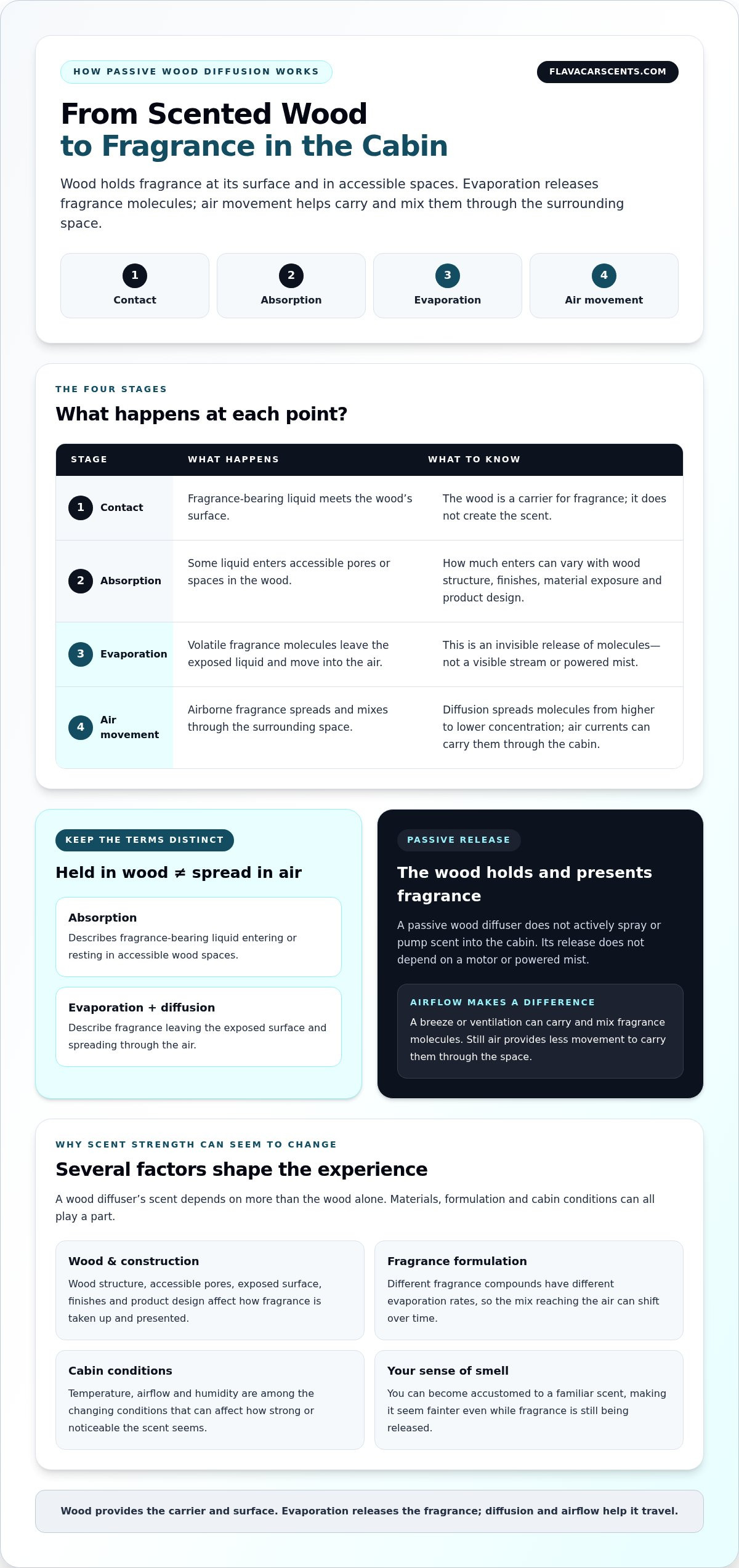
The journey from scented material to noticeable fragrance has four stages. Liquid contacts the wood, some enters accessible pores or surface spaces, fragrance compounds evaporate from exposed areas, and air movement carries and mixes them through the surrounding space. Each stage matters, but the processes do not all happen in the same way or at the same rate.
- Contact: Fragrance-bearing liquid meets the wood’s surface.
- Absorption: Some liquid enters accessible pores or spaces, depending on the material and design.
- Surface evaporation: Volatile fragrance compounds leave the exposed liquid and enter the air.
- Air movement: Air currents carry and mix airborne compounds beyond the wood.
How porous wood takes up fragrance
Wood is not a uniform sponge. Its pore structure and exposed surface can influence how fragrance-bearing liquid is taken up and where it sits. Capillary action describes liquid movement through narrow spaces and can help explain movement through accessible structures in wood. It does not mean every wood type draws in liquid in the same way.
Finishes and product designs can also affect how much of the material is exposed or accessible to the liquid. Do not assume all wood diffusers absorb fragrance identically, or infer a particular wood type or treatment from appearance alone. The material provides a pathway and surface; the product’s construction and fragrance formulation shape the details.
How scent molecules spread beyond the wood
Once volatile compounds reach an exposed surface, some move from the liquid into the air. This is not a visible stream or mist. Fragrance is carried by molecules too small to see, which then spread through the surrounding air. A breeze or ventilation can move and mix them; still air provides less movement to carry them through the space.
Evaporation releases fragrance molecules from the surface; diffusion spreads airborne molecules from areas of higher concentration towards areas of lower concentration. Air currents can also carry scent around rather than leaving it close to the wood. The USDA Forest Service explains that the movement of chemicals through wood cell walls is a diffusion process through a solid polymer. That describes movement within wood, which is different from fragrance spreading through the air.
Fragrance formulations contain compounds with different evaporation rates. The mix reaching the air can therefore shift over time: some notes may become noticeable sooner, while others emerge more gradually. A wood diffuser’s scent experience depends on more than the wood alone. The liquid’s composition, the exposed material and the surrounding air all play a part.
This passive process is the principle behind wood diffuser car air fresheners. To see how this format fits into your cabin, explore wood diffuser car air fresheners as one option for adding fragrance to your car.
What Changes a Wood Diffuser’s Scent Strength and Reach?
The answer to “how do wood diffusers release scent” can feel different from one drive to the next. Temperature influences evaporation, airflow affects where airborne scent travels, and the amount of exposed material affects the surface available for release. These factors interact, so none works like a precise intensity dial.
Temperature, airflow, and exposed surface
A warmer cabin can encourage fragrance compounds to evaporate more readily from the exposed surface. A car parked in sunlight may therefore smell different from one that is cool after an overnight stop. That does not guarantee a stronger scent or predict how long a diffuser will last. The fragrance formulation and diffuser design matter too.
Air movement changes the experience in another way. An active vent can carry scent through the cabin, making it more noticeable in some areas. Moving air can also disperse airborne fragrance more widely, so it may not stay concentrated near the diffuser. With little airflow, fragrance may remain closer to its source.
Exposed surface is part of the picture because it influences how much material is in contact with the surrounding air. But surface area alone cannot tell you exactly how strong a fragrance will seem. The material, formulation, cabin temperature and ventilation all contribute. Treat them as a set of influences, not separate controls with guaranteed results.
Why the fragrance may seem weaker over time
A softer scent does not automatically mean the diffuser has stopped releasing fragrance. As volatile compounds leave the liquid at the surface, the supply and balance of compounds available there can change. That may alter the fragrance character as well as how noticeable it seems. The effect depends on the formulation, so there is no universal timeline for a shift.
Your perception can change too. With repeated exposure, you may become accustomed to a familiar smell, a response known as sensory adaptation or olfactory fatigue. The fragrance could still be present even if you notice it less than you did at first. Someone who has just entered the car may perceive it differently from a regular passenger.
Cabin conditions are another possible factor. A different vent setting, an open window or a change in temperature can alter how scent moves or disperses. Before concluding that the diffuser has faded, consider whether the cabin is warmer, cooler or more ventilated than it was before.
In short, scent strength and reach reflect the combined effect of temperature, airflow and exposed surface, alongside the fragrance itself and your changing perception. A warm cabin may encourage evaporation, while ventilation can carry and disperse scent. Neither guarantees a particular intensity. That is why the same wood diffuser can seem different from one drive to the next.
How to Get a More Consistent Experience from a Wood Car Diffuser
A wood car diffuser responds to its surroundings, so a consistent experience starts with a steady routine, not constant adjustment. Follow the instructions supplied with your diffuser, then give it time in ordinary driving conditions before deciding whether the scent has changed. This helps you distinguish a real difference from the effects of a warm cabin, ventilation or a familiar fragrance.
Placement and airflow in a car
Airflow influences where fragrance travels. If it is carried towards one side of the cabin, the scent may be more noticeable there; a different vent setting can change the pattern. Choose a stable position that follows the product instructions and does not obstruct your view, interfere with driving or block vehicle controls. There is no single best location for every diffuser and car.
Keep the diffuser secure, and take care to keep fragrance liquid or scented material away from surfaces that could be marked or damaged. If the product instructions describe a particular setup, follow that guidance rather than improvising with its position or handling. Small, considered adjustments are easier to assess than repeatedly moving or changing the diffuser.
How to assess scent without over-adjusting
Try a simple observe-and-adjust routine:
- Set it up as directed. Use the product’s instructions for positioning and handling.
- Drive as usual. Let the cabin settle into normal conditions before judging the fragrance.
- Notice the context. Consider whether the cabin is warm or cool and whether ventilation or an open window is moving air.
- Change one thing at a time. If needed, make a modest adjustment allowed by the instructions, then observe how the scent travels on another drive.
This gives you a clearer read on the cabin without treating fragrance release like a precise dial. A scent that seems weaker during one journey might reflect changed airflow or temperature, or simply that you have become accustomed to it. Comparing similar drives can be more useful than making several adjustments at once.
For broader advice on using different car fragrance formats, the guide to how to use a car air freshener offers a useful companion.
Once you understand how airflow and cabin conditions shape the experience, choosing a wood-based format becomes more intuitive. Explore wood diffuser car air fresheners as a passive fragrance option for your drive.
What the Science Means When Choosing a Wood Diffuser Car Air Freshener
Now you know how do wood diffusers release scent: fragrance is held at a material’s surface, evaporates into the air and moves around with the cabin’s airflow. That science sets a realistic expectation. A wood diffuser is a passive format, so its release responds to the material and the conditions around it rather than being actively driven by a powered mechanism.
Powered diffusers work differently. Depending on their design, they use power to help disperse fragrance, while wood-based diffusion relies on fragrance evaporating from the scented material. Neither mechanism is automatically the better choice. The right fit depends on the experience you want and how you prefer fragrance to enter your drive.
Questions that help match the format to your drive
Think about your routine before choosing a format. Do you prefer a passive option that releases fragrance in response to cabin conditions, or a powered mechanism designed to actively disperse it? Consider how much control you want over the release process, as well as where a diffuser can sit securely without interfering with driving.
Keep your expectations grounded. Wood type, product design, fragrance formulation, temperature and airflow can all shape the experience, so the mechanism alone cannot promise a particular scent strength or duration. Read the specific product instructions for placement and care. They explain how to use that diffuser, rather than relying on assumptions about another design.
A useful way to compare options is to ask yourself:
- Does a passive format suit the way I use my car?
- Can I position it securely and follow its care instructions?
- Will changes in cabin temperature and airflow fit the fragrance experience I want?
Explore wood diffuser car air fresheners
Flava Car Scents offers wood diffuser car air fresheners as part of its car fragrance range. In a car, surrounding conditions help shape how this wood-based release mechanism is experienced. Treat it as a format choice, not a promise of fixed intensity or performance. The science offers a practical guide: material and cabin conditions influence passive release, while powered diffusion uses a different mechanism.
Choose with your drive in mind, follow the product’s instructions, and let the mechanism inform your expectations. For a wood-based fragrance format for your car, Explore Flava Car Scents.
Make Your Next Drive Feel Like Yours
Understanding how do wood diffusers release scent gives you a clearer way to choose: focus on the kind of fragrance experience that fits your routine, then let the product’s instructions guide how you use it. Your car is personal space, and the right scent format can help set its mood, whether you prefer a passive wood diffuser or another car fragrance option.
Keep it simple. Choose a format that feels right for your drive, pay attention to how your cabin affects the experience, and adjust only as the product guidance allows. There is no need to chase a perfect setting. The best choice is one that feels natural in your everyday routine.
Flava Car Scents brings together wood diffuser car air fresheners and other car fragrance formats, giving you different ways to shape the atmosphere on the road. Ready to find a style that fits your drive? Explore Flava Car Scents and make your next journey feel a little more personal.
Frequently Asked Questions
How does a wood diffuser release fragrance?
A wood diffuser releases fragrance when scented liquid enters accessible spaces in the material, then volatile compounds leave the exposed surface and enter the air. Those airborne molecules spread around the cabin. That is the basic answer to how do wood diffusers release scent: fragrance moves from the material into the air without being sprayed as a visible mist. The precise experience depends on the diffuser’s design and fragrance formula.
Does a wood diffuser need heat or electricity to release scent?
No. A passive wood diffuser does not need electricity or a heater to release fragrance. The scented material releases fragrance without a powered mechanism, although ambient warmth may influence how quickly some compounds evaporate. Powered diffusers work differently because they use a mechanism that requires energy to disperse fragrance. If a product has specific setup or operating instructions, follow those rather than adding heat or connecting it to a power source.
Why does a wood diffuser smell stronger in a warm car?
A warm car can make fragrance compounds evaporate more readily from the diffuser’s exposed surface, which may make the scent more noticeable. The effect is not fixed: fragrance formulation, airflow and how warm the cabin becomes all matter. For instance, the scent may seem different after a car has been parked in sunlight than it does once the cabin cools. Temperature alone cannot predict the intensity you will notice.
Can airflow make a wood diffuser smell weaker?
Yes. Airflow can make fragrance seem less concentrated in one spot by carrying it around and dispersing it through the cabin. An active vent may send scent towards one area, while an open window can move air out of the car. That does not necessarily mean the diffuser has stopped releasing fragrance. If the scent seems different, compare your ventilation settings and cabin conditions before changing the diffuser.
How long does a wood car diffuser last?
There is no single reliable duration that applies to every wood car diffuser. Longevity can depend on the product’s design, fragrance formulation, how much material is exposed and conditions such as warmth and airflow. How noticeable the scent feels can also change as you become used to it. Follow the product’s instructions and assess its condition over time rather than relying on a general estimate for a different diffuser.
Can a wood diffuser be refilled?
Refillability depends on the particular diffuser’s design and instructions. Do not assume a wood diffuser can be topped up just because another fragrance format is refillable. Adding liquid where it is not intended could cause leakage or damage. Follow the product guidance on whether refilling is suitable and how it should be done. If the instructions do not describe refilling, use the diffuser as directed rather than improvising.
Is a wood diffuser suitable for every car interior?
Not necessarily. Interior materials and finishes vary, and fragrance liquid may mark or damage some surfaces if it spills or makes contact. Follow the diffuser’s placement and care instructions, secure it as directed, and keep scented materials away from vulnerable trim. Make sure it cannot obstruct your view or interfere with vehicle controls. If a spill occurs, follow the product guidance and your vehicle-care instructions for the affected surface.


Leave a comment
This site is protected by hCaptcha and the hCaptcha Privacy Policy and Terms of Service apply.