

Table of Contents
- What Happens When You Inhale Car Perfume Sprays
- Car Fragrance Ingredients to Avoid
- Health Risks: From Headaches to Asthma Triggers
- How to Use Car Perfume Safely on Every Commute
- Choosing a Non-Toxic Car Air Freshener
- Ventilation and AC Maintenance vs Masking Odours
- Conclusion
- Frequently Asked Questions
Last Updated: September 20, 2026
What Happens When You Inhale Car Perfume Sprays
Car perfume sprays are formulated fragrance products designed to scent a vehicle's interior, typically delivered through an aerosol or pump mechanism that disperses fine droplets into the air. When you inhale them, those droplets carry volatile organic compounds (VOCs) directly into your respiratory tract, where they can irritate mucous membranes and trigger symptoms in sensitive individuals.
This guide breaks down exactly what you are breathing in, which ingredients warrant caution, and how to enjoy a beautifully scented car without compromising your health.
The key point most people miss: the question is not whether fragrance is inherently dangerous, but whether the specific formulation and the enclosed space you are spraying it into create a risk profile. A car cabin is one of the smallest, most poorly ventilated environments you regularly occupy. Whatever you aerosolise into it, you then breathe.
Ventilation matters enormously here. The UK Health and Safety Executive guidance on air quality notes that indoor air pollutants concentrate far more readily in small, enclosed spaces. A moving car with windows up and recirculated air is precisely that.
Car Fragrance Ingredients to Avoid
Certain ingredients appear repeatedly in cheap car fragrance products and are worth knowing by name. But naming them is only half the job. The real skill is being able to look at a bottle, a can or an online listing and work out whether any of them are present, because fragrance labelling is deliberately unhelpful.
Here is how to decode what you are actually buying.
Start with the ingredient panel, not the front of the pack
Under UK cosmetics and chemical labelling rules, a fragrance product sold as a cosmetic or air freshener must list its ingredients, but fragrance compounds themselves can be grouped under a single catch-all term: "parfum", "fragrance" or "aroma". That single word can legally stand in for dozens of individual chemicals. It is the most important thing to understand about this category.
The specific names worth scanning for
Phthalates. These are used as fixatives, they slow evaporation so a scent lingers longer. On a label they usually appear as diethyl phthalate (DEP), diethylhexyl phthalate (DEHP) or dibutyl phthalate (DBP). They are classified as potential endocrine disruptors, meaning they can interfere with hormone signalling. A product that lists "parfum" and nothing else may well contain them without saying so.
A quick label-reading routine
- Find the ingredient list, usually on the back, the base, or a folded leaflet inside the packaging.
- If the only fragrance entry is "parfum" or "fragrance", treat the product as undisclosed. That is not proof of harm, but it removes your ability to make an informed choice.
- Scan for the preservative names above. If any appear, and you have asthma or chemical sensitivity, put it back.
- Check the format. A pressurised aerosol adds propellant particles on top of the fragrance itself; a vent clip or reed diffuser releases scent passively at a far lower concentration.
- Look for a full ingredient disclosure rather than a marketing claim like "natural" or "toxin-free", neither of which is a regulated term with a fixed meaning.
What "natural" does and does not tell you
A plant-derived ingredient is not automatically safer to inhale. Some essential oils, citrus, eucalyptus, peppermint and cinnamon among them, are themselves respiratory irritants at high concentration, and they can trigger reactions in people with existing sensitivities. The useful distinction is not natural versus synthetic. It is disclosed versus undisclosed, and controlled concentration versus an uncontrolled burst.
Health Risks: From Headaches to Asthma Triggers
The most common acute symptoms reported from inhaling concentrated fragrance are headaches, nausea, dizziness, and respiratory irritation. These are not imagined reactions. They are the body responding to airborne pollutants and aerosolised particles it was not designed to process in high concentration.
Signs of Chemical Sensitivity You Should Not Ignore
- A headache that appears within minutes of spraying and fades once you exit the car
- Persistent coughing, sneezing, or a scratchy throat during your commute
- Nausea or dizziness that you have previously attributed to tiredness
- Worsening reactions to scents you used to tolerate without issue
- Watery eyes or a runny nose triggered specifically by your car's fragrance
If several of these sound familiar, your car's fragrance is a reasonable suspect. Removing it for two weeks is a simple, free test.
How to Use Car Perfume Safely on Every Commute
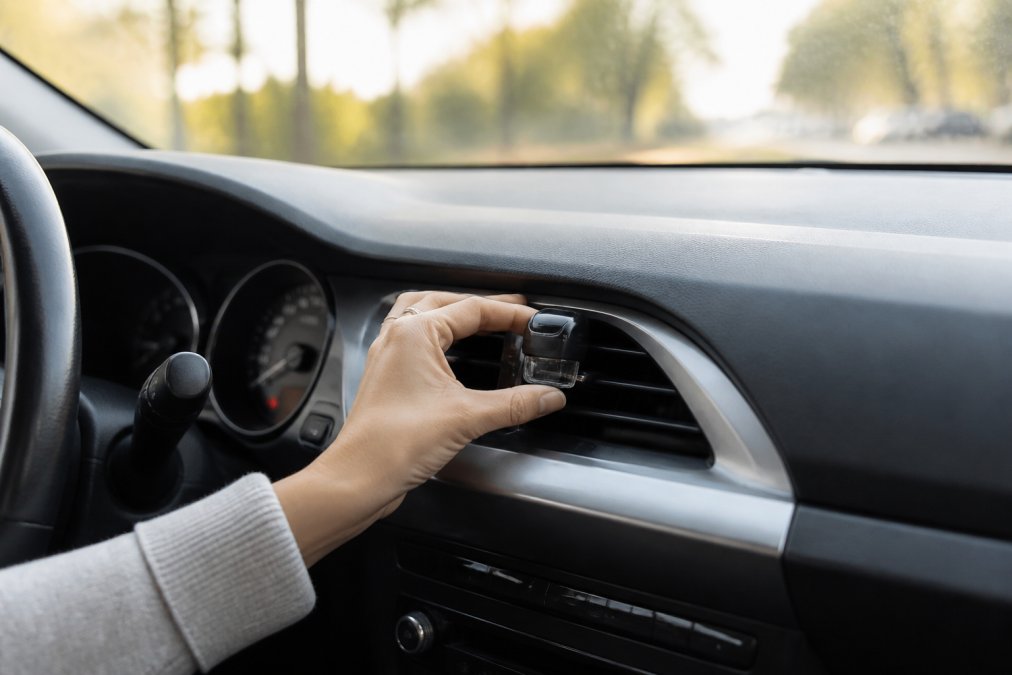
Safe use comes down to three variables: how much you apply, when you apply it, and how well the cabin ventilates afterwards. Spraying heavily into a sealed, stationary car before you set off is the worst possible method, because the particles have nowhere to go except into your lungs.
Why the car cabin is the problem, not the fragrance
A typical car cabin holds roughly 2 to 3 cubic metres of air. A domestic living room holds well over 30. That means the same single burst of fragrance produces a concentration in your car many times higher than it would in a room, and if the windows are up and the ventilation is on recirculate, that air is simply cycled around you rather than exchanged.
A practical protocol
- Apply when the car is empty, or before passengers get in. Never spray toward a person, and never toward a child in a car seat.
- Use one or two short bursts, not a sustained spray. More product does not mean longer-lasting scent, it means more airborne particles for the same result. If the scent fades within an hour, the fix is a better formulation, not a heavier application.
- Ventilate immediately after. Open a window for the first few minutes, or run the fan on fresh-air mode rather than recirculate. This is the single most effective step, because it replaces the concentrated air rather than recycling it.
- Never spray while driving. It distracts you, and it concentrates the product directly around your face and breathing zone.
- Ventilate the cabin daily, even in winter. A brief air exchange on every journey makes a measurable difference to the total load you breathe over a week.
- Give it a break. If you use fragrance every single day, your nose adapts and you tend to apply more to compensate. Rotating it, or going without for a few days, resets both your perception and your exposure.
The recirculate button is working against you
Most drivers leave the ventilation on recirculate out of habit, especially in cold weather, because it warms the cabin faster. But recirculate mode deliberately reuses the air already inside the car. If you have just added fragrance, you are concentrating it with every pass through the system.
If you are sensitive, test before you commit
A simple approach: apply the product once, ventilate, and note how you feel over the following hour. If you get a headache, a scratchy throat or watery eyes, stop using it and ventilate thoroughly. Removing the product for two weeks is a free and reliable way to confirm whether it was the cause.
Choosing a Non-Toxic Car Air Freshener
A non-toxic car air freshener is one that discloses its ingredients, avoids phthalates and formaldehyde-releasing preservatives, and delivers scent at a controlled rate rather than as an aerosol burst. The distinction between natural and synthetic fragrances matters less than disclosure and concentration.
| What to Check | Red Flag | Better Choice |
|---|---|---|
| Ingredient list | "Parfum" only | Full disclosure |
| Format | Pressurised aerosol | Vent clip or diffuser |
| Scent strength | Overpowering | Adjustable |
| Longevity claim | Vague | Specific and tested |
| Base | Undisclosed solvents | Named carrier |
Ventilation and AC Maintenance vs Masking Odours
A car air freshener should complement a clean cabin, not substitute for one. If your car smells unpleasant, masking it with fragrance simply layers one set of airborne particles on top of another, and the underlying cause remains.
Conclusion
The honest answer is that car perfume sprays are safe for most people when used in moderation, in a ventilated cabin, and with a formulation that discloses what it contains. They become a problem when they are over-applied in a sealed space, or when the ingredients are hidden behind a single vague word. If you are chemically sensitive or asthmatic, treat fragrance as something to test carefully rather than assume is harmless.
Frequently Asked Questions
Is it safe to use car perfume sprays every day?
Daily use is generally fine if the product is formulated with lower levels of volatile organic compounds and you keep the cabin ventilated. The risk comes from chronic exposure in a small, enclosed space, especially in warm weather when VOCs release faster. Limit sprays to one or two bursts, open a window for a few minutes afterwards, and take breaks from fragrance if you notice headaches, dizziness, or mucous membrane irritation.
What ingredients should I avoid in car air fresheners?
Look at the label for phthalates, formaldehyde-releasing preservatives, synthetic musks, and vague terms like 'parfum' or 'fragrance' that hide dozens of undisclosed chemicals. These are linked to endocrine disruption, respiratory irritation, and allergic reactions.
Can car perfume sprays cause respiratory issues?
They can. Aerosolised particles and VOCs from synthetic fragrance can trigger asthma attacks, wheezing, and allergic reactions in sensitive people. Those with existing asthma or chemical sensitivity are most at risk. If you notice coughing, shortness of breath, or a tight chest after using a spray, stop using it and ventilate the car. Choosing a low-VOC, non-aerosol format reduces the amount of airborne pollutants you inhale.
Are designer-inspired car scents safer than synthetic alternatives?
Not automatically. 'Designer-inspired' describes the scent profile, not the safety of the formulation. What matters is the ingredient list and how the fragrance is delivered.

Leave a comment
This site is protected by hCaptcha and the hCaptcha Privacy Policy and Terms of Service apply.